
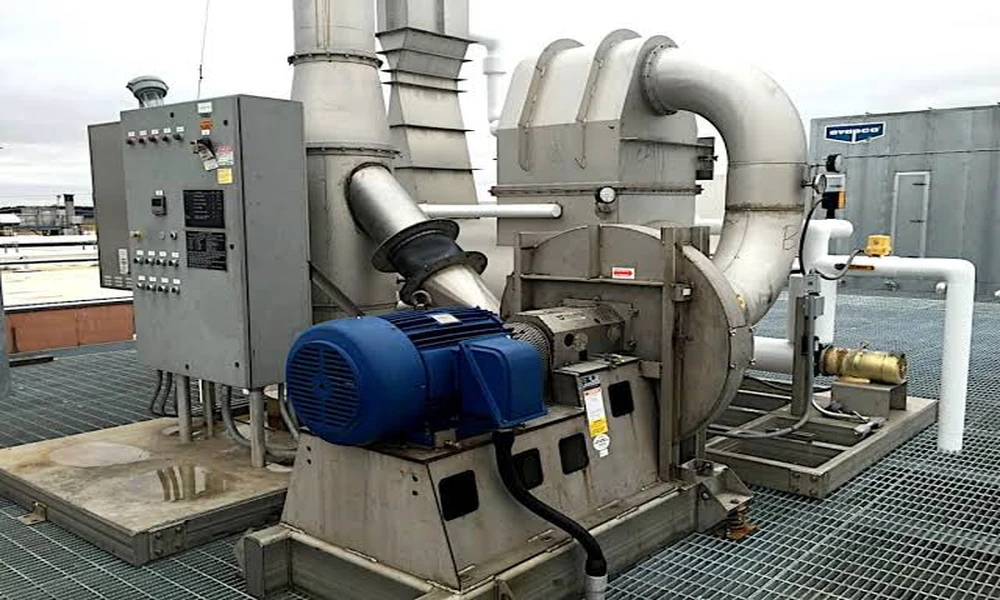

Industrial facilities generate exhaust streams loaded with dust, fumes, vapors, and mists. Left untreated, those pollutants create compliance problems, health hazards, and neighborhood complaints. Among the many devices developed to clean industrial gas streams, the venturi scrubber remains one of the most effective solutions for capturing fine particles, especially particles too small for many other collection systems to catch reliably.
If you work in plant engineering, environmental compliance, or process design, you have probably heard the term. But how these units actually capture particles, and why they excel at submicron collection, is not always well understood. This article explains what a venturi scrubber is, the physics behind how it works, and where it fits among the other air pollution control options available today.
The Basic Idea
A venturi scrubber is a type of wet scrubber. Wet scrubbers clean gas by bringing the polluted stream into contact with a liquid, almost always water. The pollutants transfer into the liquid droplets, and the cleaned gas passes on downstream. The contaminated liquid is then separated out and handled as a liquid waste stream, which is usually much easier to deal with than a dusty solid.
What sets the venturi scrubber apart from other wet scrubber designs is how it creates that contact. The name comes from the venturi, a pipe section that narrows down to a constricted throat and then opens up again. When gas is forced through that throat, it accelerates dramatically, in much the same way water speeds up when you put your thumb over a garden hose.
That acceleration is the heart of the whole process.
How the Capture Actually Happens
The sequence of events inside a venturi scrubber goes something like this.
First, the dirty gas stream enters the converging section of the venturi and begins accelerating toward the throat. Scrubbing liquid is introduced into the stream, either just before the throat or directly into it, depending on the design.
At the throat, everything happens at once. The gas reaches its maximum velocity, often hundreds of feet per second. The fast moving gas shears the liquid into an enormous number of tiny droplets. This atomization is critical, because small droplets present far more total surface area than large ones, and surface area is what drives particle capture.
Then comes the collision. Particles traveling in the gas stream have momentum. When the gas is forced to accelerate and then change direction around billions of suspended droplets, the larger particles cannot follow those sharp turns. Their inertia carries them straight into the droplets, where they are captured and absorbed. This mechanism is called inertial impaction, and it is the primary way venturi scrubbers collect particulate.
The smaller the particle, the more easily it follows the gas flow around a droplet, which is why fine particles are hard to catch everywhere, not just in scrubbers. But the extreme velocities inside a venturi throat generate enough relative velocity between particles and droplets that even submicron particles, those smaller than one micron, get driven into the liquid. That is the reason venturi scrubbers are known as high energy devices: they spend fan energy to create the conditions that make fine particle capture possible.
After the throat, the flow enters the diverging section, where the gas decelerates and some pressure recovers. The droplets, now loaded with captured particles, continue downstream to a separation stage.
The Separation Step
Capturing the particles is only half the job. The scrubber also has to get the liquid, now carrying the collected particulate, out of the gas stream before it heads to the stack.
Most venturi scrubber systems handle this with a separator vessel, often a cyclonic separator. The mixture enters the vessel and is given a swirling motion. Heavier materials, the liquid droplets and the solids they carry, travel outward along the walls of the vessel under inertial forces. The cleaned gas migrates toward the center. With the outlets positioned to take advantage of that split, the two streams are separated cleanly.
The collected liquid drains away for treatment or disposal, and the cleaned gas exits toward the stack or to further processing. In a well designed system, the gas leaving the separator is essentially free of both the original particulate and the scrubbing liquid.
The Pressure Drop Connection
If you take away one technical point from this article, make it this one: in a venturi scrubber, removal efficiency is tied directly to pressure drop across the throat.
A tighter throat means higher gas velocity, finer droplet atomization, and more violent particle-to-droplet collisions. All of that improves collection efficiency, and in many applications efficiencies up to 99 percent are achievable. The tradeoff is energy. Every inch of water of additional pressure drop has to be supplied by the fan, and fan energy costs money every hour the system runs.
This is why venturi scrubbers are often described with the phrase “high energy.” They are not complicated machines, but they do consume more energy than low pressure drop devices like spray towers. The design challenge for an application engineer is finding the throat configuration and pressure drop that hits the required emission limit without spending more energy than necessary.
Some designs address this with adjustable throats, which allow the pressure drop, and therefore the efficiency, to be tuned to changing operating conditions. Running a lighter load or an easier particulate means the throat can open up and save energy. A heavier or finer particulate load means tightening down for maximum collection.
Why Wet Collection Beats Dry for Some Applications
Venturi scrubbers are not the only particulate control option. Baghouses and electrostatic precipitators both collect dry, and for many applications they work well. So why choose a wet system?
Wet scrubbers shine in conditions that punish dry collectors. Hot or humid gas streams that would require extensive cooling before a fabric filter can handle them are fine in a scrubber. Sticky or hygroscopic dust that blinds filter bags is simply washed away. Corrosive or combustible particulate that creates explosion risk in a dry collector is rendered inert in water.
There is also a footprint advantage. A venturi scrubber system packs the collection and separation functions into a relatively compact arrangement, which matters in plants where space is tight.
The downsides are real too. You need a water supply and a plan for the resulting wastewater. And the energy consumption for submicron collection is higher than what a baghouse might need for the same job. Those tradeoffs are why scrubber selection should always start with a hard look at the contaminant characteristics, the gas conditions, and the emission requirement.
Where Venturi Scrubbers Show Up
The applications are broad. Combustion off-gas treatment is a classic one, since combustion exhaust carries a difficult mix of dusts, fumes, and acid vapors. Lime dust removal from storage vents is another common use, where the fine, alkaline dust from silo filling operations has to be kept out of the surrounding air. Foundries, incinerators, chemical plants, steel mills, and mining and minerals operations all use venturi scrubbing for particulate that resists simpler collection methods.
In many of these applications, the gas stream is too hot, too wet, or too dirty for a dry collector to survive, which is exactly the territory where wet scrubbing earns its keep.
A Few Practical Takeaways
For anyone evaluating particulate control options, a few principles are worth remembering. Know your particle size distribution, because submicron content drives the whole equipment selection. Know your gas conditions, including temperature and moisture, since they determine whether dry collection is even viable. Understand that efficiency in a venturi scrubber is purchased with pressure drop, and pressure drop is purchased with fan energy. And plan for the liquid side of the process, because a wet scrubber is only as good as its water handling and separation.
Wrapping Up
A venturi scrubber does its job with remarkably little mechanical complexity. There are no filters to blind, no electrodes to foul, and no moving parts inside the gas path. Just a constriction, a water supply, and the physics of high velocity collision. Dirty gas accelerates through the throat, water is atomized into a dense spray of fine droplets, particles are driven into those droplets by their own inertia, and a separator removes the loaded liquid before the gas is released.
That simplicity, combined with the ability to capture particulate that other systems struggle with, has kept venturi scrubbers in service across heavy industry for decades. For plants dealing with fine, difficult, or hot particulate emissions, they remain one of the most dependable tools in the pollution control toolbox.
What Is a Venturi Scrubber and How Does It Work?