

In manufacturing and industrial operations, even a small issue with a mechanical assembly can affect the performance of an entire machine. Loose bearings, shifting shafts, and components exposed to constant vibration can create maintenance challenges, particularly in equipment that operates for extended periods.
This is why retaining compounds have become an important part of modern industrial assembly and maintenance practices. They help secure cylindrical metal components, improve joint stability, and reduce unwanted movement between fitted surfaces.
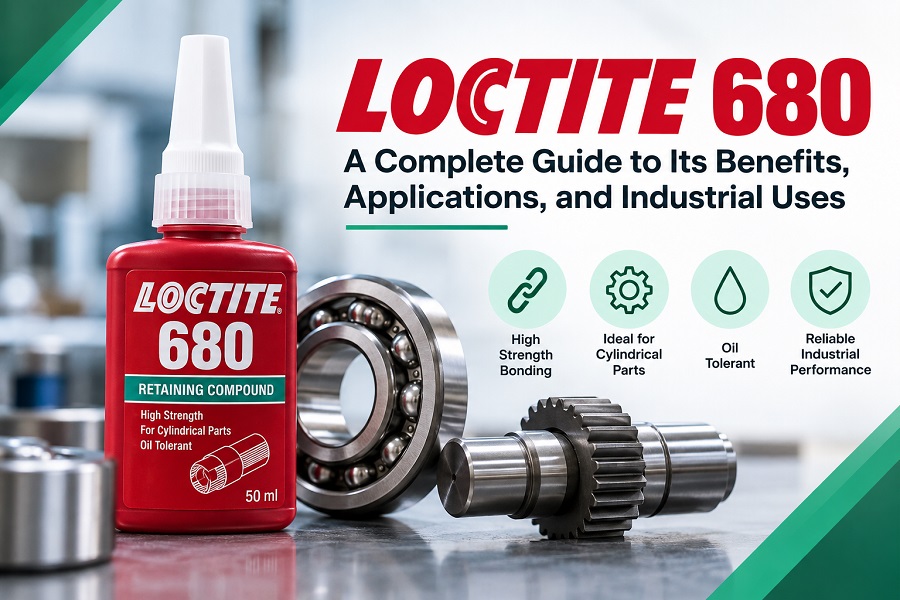
Among the products used for these applications, Loctite 680 is known for its high-strength bonding capabilities and relatively low viscosity. It is designed for securing metal components where reliable retention is essential, including bearings, shafts, bushings, and other cylindrical assemblies.
Understanding how this product works, where it can be used, and how to apply it correctly can help manufacturers, maintenance professionals, and engineering businesses make more informed decisions.
What Is Loctite 680?
Loctite 680 is a high-strength, one-component anaerobic retaining compound developed by Henkel. It is a green liquid adhesive formulated to bond cylindrical metal components, particularly in applications where good flow characteristics are required.
Unlike ordinary adhesives that cure through exposure to air, anaerobic retaining compounds cure when confined between closely fitted metal surfaces in the absence of oxygen.
Once cured, the compound creates a strong bond between the mating surfaces, helping prevent movement caused by vibration, mechanical shock, and operational loads.
One of its distinguishing characteristics is its ability to work on different metal substrates, including active metals such as mild steel and less-reactive materials such as stainless steel and plated surfaces.
The product also tolerates minor oil contamination, which can be useful in industrial environments where components may have contact with lubricants or protective fluids.
For businesses involved in equipment manufacturing, machinery repair, and industrial maintenance, Loctite 680 provides an additional method of securing suitable metal assemblies.
Key Benefits of Loctite 680
Selecting a retaining compound involves more than simply looking at its bonding strength. Factors such as application requirements, surface condition, curing behavior, and operating environment also matter.
Loctite 680 offers several characteristics that make it useful in industrial settings.
1. High-Strength Bonding
One of the primary advantages of Loctite 680 is its high-strength retention capability.
When applied to suitable cylindrical metal assemblies, it helps create a secure connection between components. This can be particularly useful in applications where mechanical movement or loosening could affect equipment performance.
For example, bearing housings and shaft assemblies may experience continuous operational forces. A properly selected retaining compound can help maintain the position of these components during service.
2. Low Viscosity for Better Surface Coverage
Loctite 680 has relatively low viscosity compared with certain other retaining compounds.
This allows it to spread across closely fitted surfaces and helps achieve consistent adhesive coverage during assembly.
In manufacturing environments, uniform application is important because incomplete coverage may affect the reliability of the finished joint.
Its flow characteristics make it suitable for applications involving slip-fitted and other cylindrical metal components.
3. Resistance to Vibration and Mechanical Shock
Industrial machinery frequently operates under vibration and changing mechanical loads.
Over time, these conditions may contribute to loosening or movement between metal components, especially when the original fit has deteriorated.
Loctite 680 helps resist such movement by bonding the mating surfaces together.
This characteristic is useful in motors, pumps, gearboxes, and other equipment where assembly stability is important for continuous operation.
4. Compatibility With Different Metal Substrates
Not all metals behave the same way during adhesive curing.
Some surfaces are more reactive, while others, including certain stainless steel and plated materials, may require additional consideration.
Loctite 680 is formulated to provide reliable curing performance on both active and passive metal substrates.
This makes it a practical option for businesses working with different metal components, although the specific material combination should always be checked against the manufacturer’s technical recommendations.
5. Tolerance to Minor Oil Contamination
Oil and lubricant exposure is common in industrial assembly and maintenance work.
Loctite 680 can tolerate minor contamination from certain oils, including cutting fluids, lubricating oils, and protective fluids.
This feature offers additional flexibility when working with industrial components.
However, it should not be treated as a replacement for proper cleaning. Removing excessive oil, grease, dirt, and other contaminants remains an important part of achieving consistent results.
6. Support for Equipment Reliability
Unexpected equipment downtime can affect production schedules, maintenance budgets, and business operations.
A suitable retaining compound can help reduce assembly-related movement and support the reliability of mechanical connections.
For maintenance teams, this provides another option when addressing certain loose-fitting components, provided the condition of the parts and the engineering requirements allow its use.
Common Industrial Applications of Loctite 680
Loctite 680 is primarily intended for cylindrical metal assemblies. Its use extends across several industrial and engineering applications.
Bearing Retention
Bearings are essential components in rotating machinery. They support shafts, manage mechanical loads, and help maintain smooth operation.
When a bearing becomes loose within its housing or on a shaft, unwanted movement may lead to noise, vibration, and premature wear.
Loctite 680 can be used in suitable bearing retention applications to help secure the components and maintain a stable fit.
It may also be considered during certain maintenance procedures where the existing component condition permits adhesive retention.
Shaft and Hub Assemblies
Shafts and hubs are widely used in motors, pumps, gearboxes, and power transmission systems.
These components must remain properly positioned while handling rotational forces and mechanical loads.
Applying a suitable retaining compound between closely fitted surfaces can help strengthen the connection and reduce unwanted movement.
Loctite 680 is particularly relevant where a high-strength bond and appropriate flow characteristics are required.
Bushings and Sleeves
Bushings and sleeves are used in machinery to support movement, alignment, and load distribution.
In certain applications, these components may develop looseness due to wear or operating conditions.
Where the assembly design allows it, a retaining compound can help secure the cylindrical surfaces and improve joint stability.
Before using the product, it is important to determine whether the component requires adhesive retention or complete replacement.
Gears and Pulleys
Gears and pulleys are important elements in mechanical power transmission.
Their connections must remain stable to support consistent equipment operation.
Loctite 680 may be suitable for securing certain gear, pulley, and hub assemblies where cylindrical metal fitting surfaces are involved.
The final selection should account for the component dimensions, clearance, mechanical loading, and service conditions.
Industrial Machinery Repair
Maintenance professionals frequently encounter loose-fitting metal components in older equipment.
In some situations, retaining compounds provide a practical repair option that may help extend the service life of suitable assemblies.
However, severe wear, damaged components, or excessive gaps require a proper engineering assessment. A retaining compound should not be used as a substitute for repairing or replacing parts that no longer meet operating requirements.
How to Use Loctite 680 Correctly
Although Loctite 680 is supplied as a ready-to-use liquid, correct application plays a major role in its performance.
Following a consistent procedure helps improve coverage, curing, and assembly reliability.
Step 1: Clean and Inspect the Surfaces
Begin by examining the components for dirt, corrosion, excessive oil, and old adhesive residue.
Clean the mating surfaces with a compatible cleaning product and allow them to dry.
Henkel recommends appropriate surface preparation to support consistent bonding performance.
Also inspect the parts for excessive wear, damage, or clearances beyond the product’s intended application range.
Step 2: Consider the Need for an Activator
The curing speed of anaerobic retaining compounds can vary depending on the metal substrate, temperature, and bond gap.
On less-reactive metals or in lower-temperature conditions, a compatible activator may help accelerate curing.
If required, use an activator recommended by the manufacturer and allow it to dry according to the product instructions.
Step 3: Apply the Compound
For slip-fitted assemblies, apply Loctite 680 around the leading edge of the male component and to the corresponding internal surface of the female component.
Use a rotating motion while assembling the parts to encourage even distribution.
For press-fitted components, apply the compound to the appropriate bonding surfaces before completing the assembly using the recommended method.
Remove excess adhesive from exposed areas.
Step 4: Assemble the Components Properly
The assembly method depends on the equipment design.
Slip fitting, press fitting, and shrink fitting may require different application techniques.
For shrink-fitted assemblies, follow the approved heating and installation procedure. Avoid improvising temperature or force requirements.
Correct assembly helps ensure that the retaining compound is distributed across the intended bonding area.
Step 5: Allow Adequate Curing Time
Once the components have been assembled, allow sufficient time for the compound to cure before applying the full operating load.
Henkel specifies a typical full cure time of approximately 24 hours at 22°C, although actual performance varies with substrate, temperature, and clearance.
For critical industrial equipment, follow the latest technical data sheet and the equipment manufacturer’s requirements before returning the assembly to service.
Important Factors to Consider Before Application
Before choosing Loctite 680 for an industrial project, businesses should evaluate several practical considerations.
Material compatibility: Confirm that the product is suitable for the metal substrates involved.
Bond gap: The compound is intended for appropriate fitting clearances. It is not a universal solution for severely worn components or oversized gaps.
Operating temperature: Check that the application’s temperature requirements fall within the manufacturer’s specified limits.
Mechanical loading: Consider vibration, rotational forces, shock, and other operational stresses.
Surface preparation: Minor oil tolerance does not eliminate the need for suitable cleaning and inspection.
Safety requirements: Review the latest Safety Data Sheet and follow recommended handling and personal protective equipment procedures.
Taking these factors into account helps businesses select a suitable retaining solution and avoid unnecessary assembly problems.
The Role of Retaining Compounds in Modern Manufacturing
Manufacturing businesses are continually looking for ways to improve production efficiency, maintain equipment reliability, and manage operating costs.
Retaining compounds support these objectives by providing an alternative or complementary method of securing cylindrical metal components.
In appropriate applications, they can help reduce movement between fitted surfaces, support consistent assembly quality, and address certain maintenance requirements.
For production facilities, this can contribute to more dependable equipment operation. For maintenance teams, it provides another option when evaluating loose-fitting components.
The important consideration is choosing the correct product for the specific assembly rather than relying on a single solution for every mechanical application.
Final Thoughts
Loctite 680 is a high-strength anaerobic retaining compound designed for securing cylindrical metal components in industrial and engineering environments.
Its relatively low viscosity, resistance to vibration, tolerance to minor oil contamination, and compatibility with different metal substrates make it relevant to applications involving bearings, shafts, bushings, and other fitted assemblies.
For businesses involved in manufacturing, equipment maintenance, and industrial operations, understanding how retaining compounds work can help improve assembly decisions and support equipment reliability.
As with any industrial adhesive, proper surface preparation, correct application, and sufficient curing time are essential. Consulting the manufacturer’s latest technical documentation ensures that the product is used appropriately for the intended application.